'We haven't even started yet'
Unite marks IWMD in Liverpool with vow to action on construction suicides
Reading time: 9 min
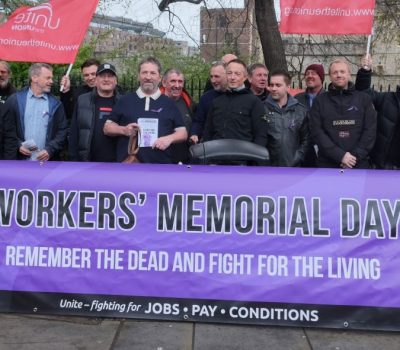
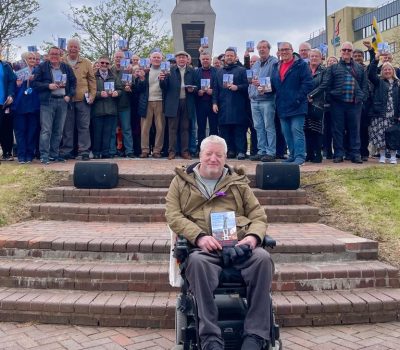
Every International Workers’ Memorial Day (IWMD), Unite members gather in droves by the Harry the Hod statue in Liverpool, just yards away from the union’s Jack Jones House.
This year was no different, with members across sectors as well as politicians and campaigners coming to pay their respects on Tuesday (April 28) in one of the largest IWMD events in the entire region.
What was different this year was the day’s focus – on a growing but hidden issue that Unite is working hard to tackle: workplace mental health and psychosocial risks, the chosen IWMD theme this year.
Mental ill health is so insidious in construction specifically, that two workers in the sector die by suicide each and every day. According to the most recent figures, an astonishing 7,000 building workers have taken their own lives over the last decade. Workers in construction have a suicide rate four times the national average.
Unite retired member and former building worker Kenny Routledge knows all too well the dangers of ignoring mental health problems in the sector – he himself once contemplated suicide, motivated in part by workplace stress. Although he came out the other end, he’ll never forget how close he was.

“That feeling never leaves you,” he told UniteLive. “It was the stress of the job, the isolation and the low pay that all got on top of me. That’s why I’m so passionate about talking about mental health in construction today.”
Kenny said that working conditions in the construction sector are still “terrible” and he believes a big problem exacerbating workplace mental ill health is “lack of direct employment” in the industry.
He also adds that it is not only the person who takes their own lives who is affected – of those 7000 construction workers who’ve died by suicide, a huge toll is taken on the hundreds of thousands more, if you include family members, friends and colleagues.
“You can’t imagine what that feels like for friends and family. They’re burdened not just with grief for their lost loved one, but with the guilt of always thinking maybe they could have done something to stop them.”
UniteLive also caught up with Labour councillor for Fazakerley East Debbie Cooke, and her colleague Maureen Daly (pictured below L-R). Both Unite members with a background in social work, they started coming to IWMD in Liverpool from last year.

“Both our husbands are building workers, so these issues are close to our hearts,” Debbie said. “It’s important to remember those who’ve died during the course of their work. And it’s also so vital that we ensure health and safety is adhered to in our workplaces. Take the tragic loss of the young man who died on-site in the construction of Everton [FC]’s new ground – it’s not just times gone by that fatalities happen; it’s happening now too.”
Maureen agreed.
“My husband knows many people who’ve fallen off scaffolding – it’s becoming more of a problem,” she said.
Commenting on poor mental health in the sector, both Maureen and Debbie believe working conditions are a big contributing factor.
“Years ago – and still today – much of the work in construction is insecure,” Maureen explained. “You’ve got people who are trying desperately to provide for their families, and when they struggle to do that, it takes a big toll.”
Maureen and Debbie both surmise that another contributing factor to the worsening mental health crisis in construction is the male-dominated nature of the workplace.
“Men just don’t tend to talk about mental health and that needs to change,” Debbie noted. “There’s lots of banter at work among men. A lot of it is harmless, but sometimes it can make people’s mental health struggles worse.”
Unite regional coordinating officer Tanya Sweeney (pictured below right) said she felt it was vital that trade unionists take time to commemorate people who’ve lost their lives in work.

“No one should die just going about their daily lives in work to support their families,” she said. “It’s important that we as trade union members continue to fight for health and safety.”
She went on to highlight some of the work Unite is doing regionally.
“We have local health and safety committees that meet regularly to discuss improvements. There’s a big focus now on mental health,” Tanya said, adding that suicide awareness, especially in the construction sector, is a big part of this ongoing work.
Liverpool’s IWMD event drew a diverse crowd, including two young men, Unite members Charlie and Kai (pictured below L-R), who work for Amey, a large contractor.

“Taking care of your mental health should be preached to everyone,” Charlie said. “We’ve got mental health reps at work, so if you need someone to talk to, there’s someone there. Every workplace should have them.”
Kai agreed and emphasised the importance of marking IWMD.
“Everyone should come to pay their respects,” he said. “Anyone who’s died in work should remembered.”
Unite retired member Ted, who was previously a scaffolder, knows all too well the dangers of working in construction. He recalls two separate incidents where people he was working with died on-site in work.

“It was bloody horrible,” he said. “You go out to work and expect to come home. We need to keep commemorating Workers’ Memmorial Day because incidents like these are still happening.”
A minute’s silence was held during the event, after which attendees heard from speakers, including TUC general secretary Paul Novak and Shrewsbury 24 Campaign researcher and secretary Eileen Turnbull. Local Labour MP Anneliese Midgley, another key speaker, was unable to attend due to commitments in Parliament, including her work in support of the Hillsborough Law.
In his speech, Paul Novak (pictured below) emphasised the importance of “keeping the flame alive” in the continued fight for health and safety. He also paid tribute to health and safety reps who work day in, day out to save lives.

“Our national prosperity should never be built on the blood of working people,” he said. “And that’s why health and safety should always be a priority for us – nationally and in each and every workplace.
Paul concluded to applause, “Today is our day to remember those we have lost; our day to call on governments to deliver safe workplaces; and our day to demand action not just from governments, but from regulators and employers. Our day to remember the dead and to recommit ourselves to fight for the living.”
A representative of Anneliese Midgely read her speech, with Anneliese sending her deeply felt apologies for missing the event.
Her speech highlighted the work in Parliament she and other trade union MPs are doing to fight for the highest standards in workplace health and safety in legislation.
“[Unions] don’t just talk about safety; we make it happen,” her speech read. “We organise, push back, hold employers to account and where unions are strong, workplaces are safer. But we also need laws that actually protect people.”

Meanwhile, Eileen Turnbull (pictured above) highlighted the horrifying statistics surrounding work-related deaths in construction. But she said the figures don’t account for the untold number of people who are dying from occupational stress. Eileen highlighted the poor working conditions and casual labour endemic in construction, and how all of these factors contribute to the mental health crisis in the sector.
“To change this situation, it’s not rocket science,” she concluded. “What is lacking is the political will. Trade unions have fought hard for generations and we will never give up. It can be achieved; it will be achieved. But we can only succeed if we act together.”
Unite construction NISC chair Bill Parry (pictured below) presided over the event, as various local Unite branches laid wreaths to honour fallen workers.

Concluding the event, Billy issued a strong clarion call for government action. He highlighted a meeting he and others in the Unite construction sector had with the construction minister Chris McDonald, noting that this was only the beginning.
“We ain’t going away,” he vowed. “In fact, we haven’t even started yet. We are going to take [the issue of suicides in construction] on, from the North West, to national, to the media, to local councils, to anywhere we have to go. But we are not going to ignore 7000 suicides in 10 years. We are not going to ignore the deaths and the mistreatment of construction workers. We deserve – and we’re going to get – better than this.”
By Hajera Blagg
Photos by Kamal Badhey