UniteLive's 12 days of Xmas - 'A fantastic deal'
On the eleventh day of Xmas, true grit of Unite members wins the day – and a pay rise
Reading time: 8 min
On the eleventh day of Christmas, UniteLive looks back at one of the union’s longest strikes of the year, which ended in victory in June after members employed by Livv Housing in Merseyside took a brave stand.
It was when Unite rep Dave spoke to a member on the phone who was in tears, that he knew how tough the road had become.
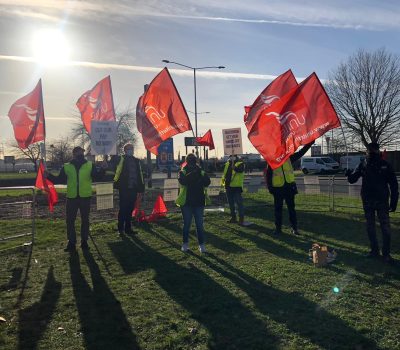
Unite members employed by social housing provider Livv, based in Knowsley, Merseyside, had been out on strike for months, since October last year. It was one of the longest-running disputes in Unite’s recent history.
“He was very upset, saying he was struggling, because his son’s birthday was coming up, and he didn’t have the money to pay for it – that took my breath back a bit,” Dave recalls, adding that there were many calls with members just like this one.
The striking workers had been through so much. They were up against a well-oiled propaganda machine driven by Livv management, and shocking union-busting tactics. This included offering workers – during Christmastime no less – a 5 per cent pay rise only if they confirmed they weren’t union members.
Dave’s phone call exemplifies the extraordinary sacrifices that members and their families made to achieve a better collective outcome for all. And those sacrifices weren’t in vain – against all odds, the striking workers won.
In June, after eight long months of strike action, the employer finally came to the table with a serious deal, and it was overwhelmingly accepted by the workforce.
The deal includes a pay rise worth between 8 and 8.5 per cent. Matched pension contributions will also increase from six per cent to 10 per cent, and a pension salary sacrifice scheme will be implemented to help members benefit from tax savings.
Workers will be given an additional three days’ annual leave a year, and there will also be an immediate reduction in the working week from 40 hours to 39 hours. What’s more, a working group from the employer and union side will be set up to look at a further reduction to 38 hours or less within 12 months.
A similar working group will be set up to review all terms and conditions.
It’s a remarkable deal, given that workers had suffered more than a decade of real-terms pay cuts. Their pay had fallen well below the average for similar jobs in the social housing sector, and even though they technically had collective bargaining, in practice, they had nothing. Year after year, workers simply had to accept below-inflation pay rises. Meanwhile, their working hours grew longer and the stress of the job more daunting.
So how exactly did Livv maintenance workers go from such a low point in industrial relations to what Unite general secretary Sharon Graham called a ‘fantastic deal’ – and for the first time in years, optimism for the future?
For Unite rep Kevin, it was a number of factors. “We had strong support from all sides – support from our tenants, from local and national politicians and of course from our union and the wider union movement,” he explained.
Kevin cited the financial, as well as tactical support from Unite, in the form of a leverage campaign, which proved instrumental.
Unite regional officer John Sheppard also spoke of the effect of the leverage campaign, what Unite calls ‘strikes plus’. ‘Strikes plus’ is a set of tactics Unite uses to place additional pressure on the employer beyond only workers withdrawing their labour.
This can take the form of publicity stunts, or press campaigns investigating the company’s accounts to reveal the truth about its finances – and the affordability of a decent pay rise. In the case of Livv, part of the ‘strikes plus’ work included establishing a hotline so that tenants could report issues they were facing with contract work carried out by maintenance workers brought in to break the strike.
John explained, “When [Unite general secretary] Sharon visited the picket line and announced that we would be moving to ‘strikes plus’, that was a big turning point in the dispute.”
John noted that a CEO of a different Liverpool housing association, who had once been subjected to a very early Unite leverage campaign, was seen at Livv offices.
“While we can’t confirm this, we suspect that [this person] may have advised Livv executives that once a leverage campaign starts, that means Unite is going nowhere,” John noted.
Leading the company’s hostile, union-busting tactics was previous CEO Léann Hearne. Shockingly, Hearne – the head of a social housing provider – said in a speech to staff that she considered Margaret Thatcher one of her heroes.
Under Hearne’s leadership, the company point-blank refused to negotiate with Unite throughout the dispute; it brought in strike-breaking contractors; and it offered what Unite believes were illegal inducements to undermine the strike.
And then, in April, Hearne suddenly announced her resignation. She cited personal reasons, but Unite believes perhaps there may have been more to it than that. UniteLive understands that an ‘extraordinary’ board meeting was held just before her resignation.
“It may have then come to light to the board, just how much money the company was wasting in needlessly prolonging the strike; it may have become clear that her position was untenable,” Kevin explained. “It would have been much cheaper to simply come to the table and understand the reasons behind the dispute and try to resolve it.”
Unite rep Dean* highlighted the overwhelming support from tenants and the wider public – it was what kept members motivated when the going got tough.
“I didn’t expect to get so much support from left, right and centre,” he noted. “I didn’t even realise how many people knew about the dispute. You’d bump into people, and they’d ask how the strike was going. Online everyone was so positive too. It was a great feeling.”
Meanwhile, Dave highlighted the importance of communication.
“The rumour mill from management was going strong, and we did have some lads who returned to work,” he explained. “Some members weren’t attending the picket line, and reps made sure to make phone calls to check in on everyone. That’s when we discovered that, for example, the member was considering crossing the line because he couldn’t afford to pay for his son’s birthday. We were then able to secure hardship payments for these members. It kept us going.”
Kevin emphasised that what ultimately won the strike was members’ determination.
“It was all about remaining strong,” he said. “It doesn’t matter how effective your union or your reps are – if members don’t remain strong, then you won’t win your dispute.”
Dean agreed.
“We won because of the resolve of the members,” he said. “I don’t think management expected us to stay out for as long as we did. Our message was simple – we only need to last one day longer than them. That message really resonated; everyone used to say it. And it worked.”
Regional officer John also praised members’ grit.
“I’m in awe of the resolve they showed,” he said. “These lads and lasses kept going, even when the propaganda machine was in full swing. Even when their families were no doubt asking them ‘How long is this going to carry on?’ Even when their bills were piling up. Yes, we had some brilliant donations to keep us going, but they were still not on full pay. It truly humbles me what they accomplished together.”
For the first time in years, Livv maintenance workers feel hopeful about the future.
Beyond the present deal, members are eager to see a new era of good industrial relations with the company, and genuine collective bargaining.
“We’re hopeful that when a new CEO is appointed, we can all work together,” Tony said. “All we want is a seat at the table, and to be listened to and treated fairly.”
Kevin agreed.
“We may have slightly different interests than our employer, but our objectives are the same – to have a vibrant company, with low staff turnover; that works safely, efficiently and effectively; and takes pride in the service we provide for tenants. If we work together, we can achieve this, and that can only benefit everyone.”
*Name changed to protect privacy
This article first appeared in buildingWORKER magazine.
By Hajera Blagg
Photo by Mark Thomas